

Related: Scale Faster: Why Delivery Automation Wins Logistics
Workflow automation tools for e-commerce automation guide e-commerce automation guide e-commerce that automate order processing, inventory management, and customer communication are integrated platforms that connect online stores, ERPs, CRMs, and fulfillment systems to execute repetitive operational tasks without manual intervention—reducing errors, accelerating fulfillment, and improving response consistency.
E-commerce businesses face mounting pressure to scale operations without proportionally scaling headcount. Manual order entry, reactive stock adjustments, and delayed customer replies erode margins and trust. The right automation infrastructure doesn’t just save time—it enforces process discipline, surfaces data-driven insights, and creates operational resilience across channels.
Key Takeaways
- Workflow automation tools for e-commerce that automate order processing, inventory management, and customer communication rely on event-driven, idempotent integrations—not point-to-point scripts—to ensure reliability at scale.
- A discovery sprint grounded in stakeholder interviews and system mapping is essential before selecting or building any automation layer, because integration success depends on business logic—not just technical compatibility.
- Growth-aligned automation prioritizes auditability, real-time monitoring, and schema validation so teams can trace failures, adjust thresholds, and maintain compliance as sales volume or channel complexity increases.
Why Generic Automation Falls Short for E-commerce
Many teams start with low-code tools like Zapier or Make—powerful for simple triggers—but quickly hit limits when handling multi-step, conditional, or stateful workflows. An order may require routing to different warehouses based on stock levels and shipping origin, applying tax rules by jurisdiction, updating loyalty points, then sending a personalized SMS only if the customer opted in. That’s not a “if-then” chain. It’s a decision graph with dependencies, fallbacks, and reconciliation requirements.
Generic tools also lack native support for idempotency—critical when payment gateways retry webhooks or inventory APIs return partial success responses. Without built-in deduplication and retry logic, duplicate orders, oversold SKUs, or missed notifications become inevitable.
Worse, most off-the-shelf connectors treat systems as black boxes. They don’t validate payload structure, enforce rate limits, or expose latency metrics per endpoint. When Shopify sends an order with malformed line item metadata—or NetSuite rejects a sync due to a missing GL account—the failure isn’t logged meaningfully. Teams spend hours debugging instead of optimizing.
That’s why purpose-built automation architecture starts with design intent—not connector availability.
The Savage Build Framework: Aligning Automation to Business Outcomes
We begin every engagement with a 5-day discovery sprint—not a requirements workshop, but a co-creation process grounded in observable behavior. We interview frontline staff (customer service reps, warehouse leads), map existing handoffs between Shopify and QuickBooks, and assess technical debt in legacy sync jobs. This reveals where automation should prevent error—not just accelerate action.
For example, one client used manual CSV uploads to update inventory across three marketplaces. Their “automation” was a shared Google Sheet with color-coded tabs. During peak season, version conflicts caused double-counting. The Savage Build Framework identified that the real constraint wasn’t speed—it was source-of-truth governance. So we architected a single inventory ledger in PostgreSQL, fed by Shopify webhooks and validated against warehouse barcode scans.
Success metrics were defined upfront: reduce stock discrepancy incidents by ≥80% (measured via weekly cycle counts), cut average order-to-ship time from 28 to <12 hours, and achieve 99.5% message delivery SLA for post-purchase SMS. These KPIs—not uptime or API call volume—guided every integration decision.
This approach prevents over-engineering. If a client processes under 50 orders/day, we may recommend a hardened Zapier workflow with custom webhook validation—not a Kubernetes-deployed microservice.
Automation-First Integration Design: Reliability by Architecture
Every integration we build follows an automation-first pattern: event-driven, idempotent, monitored, and self-healing.
Event-driven means reacting to system events—not polling. When Shopify emits an orders/create webhook, our listener validates signature, parses JSON, checks for required fields (line_items, shipping_address), and queues the order in a durable message broker (e.g., RabbitMQ). No cron jobs. No race conditions.
Idempotency ensures safe retries. Each order carries a unique idempotency_key derived from Shopify’s order_id + timestamp hash. If the same key arrives twice within 24 hours, the system skips processing—no duplicate ERP entries, no double-charged credit cards.
Schema validation happens before transformation. We define strict OpenAPI 3.0 schemas for inbound payloads and outbound ERP payloads. If Shopify sends a line_item with price as string instead of number, the system logs the violation, routes it to a quarantine queue, and alerts the ops team—not silently fails or corrupts data.
Real-time dashboards track throughput, error rates, and latency per integration leg (e.g., “Shopify → Inventory Service → NetSuite”). Alerts trigger only on sustained deviation—like >5% webhook failure rate over 15 minutes—not transient blips. This makes observability actionable, not noisy.
Order Processing Automation: From Click to Confirmation
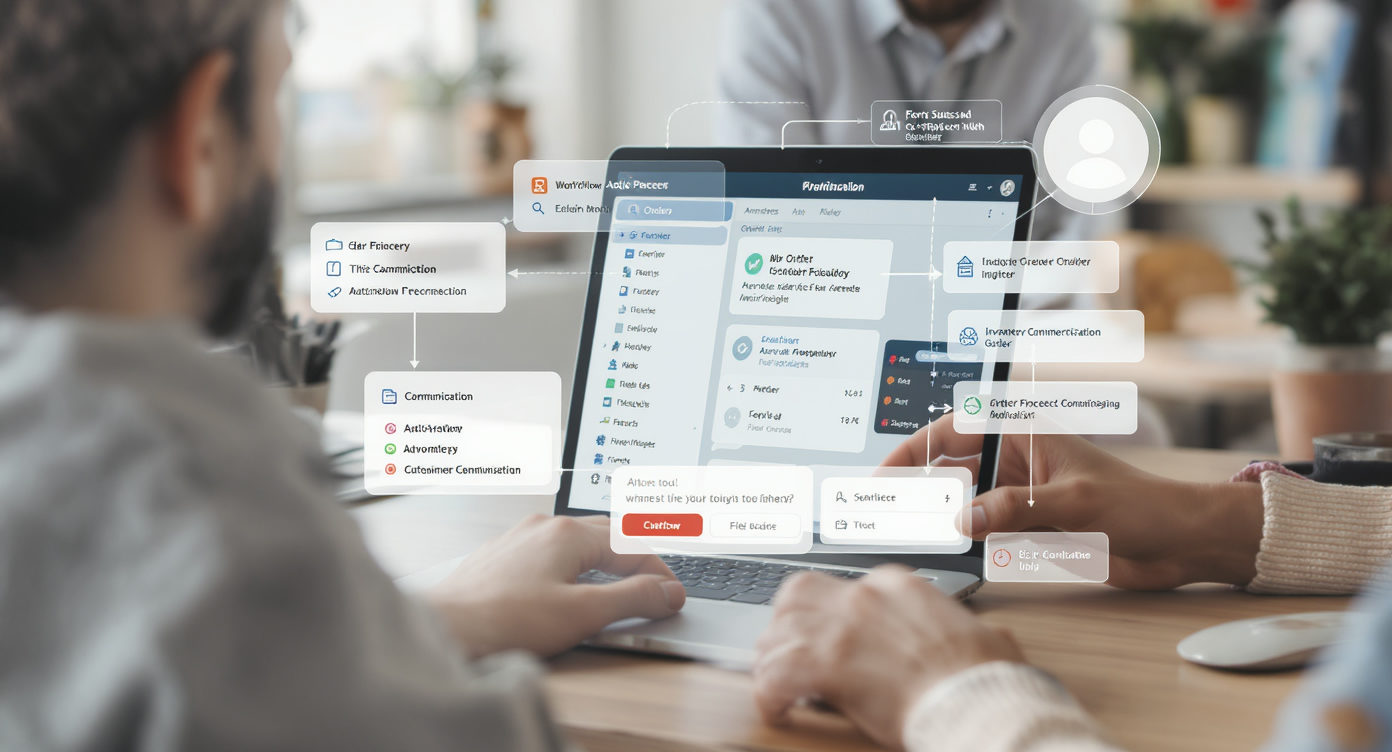
Automating order processing goes beyond syncing data. It’s about orchestrating decisions.
When an order hits the system, the workflow evaluates:
If stock is insufficient, the system doesn’t just reject—it proposes alternatives: backorder notification, substitute SKU suggestion (with image and description pulled from PIM), or expedited restock alert to procurement.
Then it triggers parallel actions:
purchase_initiated)Crucially, each step includes rollback logic. If the WMS rejects the pick ticket due to bin misconfiguration, the system pauses, notifies the warehouse manager, and holds email/SMS until resolution—preventing premature customer expectations.
This isn’t linear scripting. It’s a state machine with clear transitions, timeouts, and human-in-the-loop gates where judgment is irreplaceable.
Inventory Management Automation: Syncing Truth, Not Just Data
Inventory accuracy isn’t about frequency—it’s about fidelity. Many tools sync stock levels every 5 minutes. But if that sync ignores reserved quantities, pending returns, or quality-hold batches, it’s dangerously misleading.
Our inventory automation layers distinguish between:
Each state is updated via event, not schedule. A warehouse scan updates committed instantly. A returned package scanned at receiving updates available-to-sell and triggers a refund workflow.
We also enforce reconciliation cycles. Daily, the system compares ATS totals against ERP general ledger balances. Discrepancies >0.5% auto-generate root-cause tickets—flagging mismatches between Shopify’s variant-level count and NetSuite’s item-level ledger.
For multi-channel sellers, we implement channel-specific rules: Amazon requires FBA inventory syncs within 15 minutes of change; Walmart mandates daily feed submissions in XSD format. Our automation handles both—without requiring developers to write channel-specific parsers.
And because inventory impacts SEO (e.g., “in stock” badges affect CTR), we push real-time availability signals to structured data (schema.org/InStock) and dynamic meta descriptions—so Google indexes pages only when items are truly available.
Customer Communication Automation: Personalization at Scale
Automated messages fail when they feel robotic. The goal isn’t to replace humans—it’s to free them for high-value interactions.
We design communication workflows around context, not cadence:
All messages use dynamic personalization tokens tied to verified data sources—not just “{{first_name}}.” For example:
{{estimated_delivery_date}} pulls from carrier API + warehouse dispatch timestamp{{recommended_accessory}} uses collaborative filtering (customers who bought X also bought Y) and current stock status{{support_contact}} routes to the agent with highest CSAT score for that product categoryWe also enforce compliance guardrails: unsubscribe links auto-append to every email; SMS opt-in status is validated against TCPA-compliant consent logs; and GDPR right-to-erasure requests purge all message history across systems within 72 hours.
This level of contextual automation builds trust—not just efficiency.
Choosing the Right Tool: Platform vs. Custom-Built
Off-the-shelf platforms like ShipStation, TradeGecko (now QuickBooks Commerce), or Cin7 offer strong out-of-the-box workflows—but often force business logic into their model. If your returns policy requires photo verification before issuing store credit, and the platform only supports automated refunds, you’ll either compromise or bolt on fragile workarounds.
Conversely, fully custom solutions built on Node.js + RabbitMQ + React admin dashboards offer total control—but demand ongoing DevOps, security patching, and schema evolution management.
The pragmatic middle path? Hybrid architecture:
This balances speed, control, and maintainability. It also aligns with the Savage Build Framework’s principle: prioritize test-driven development of business rules—not infrastructure plumbing.
One client replaced a $20k/year SaaS tool with a hybrid solution costing less than half annually. More importantly, their order accuracy rose from 92% to 99.8%—not because the new tool was “faster,” but because its validation rules matched their actual fulfillment workflow.
Measuring Success Beyond Speed
Teams often measure automation success by “time saved.” That’s incomplete. True ROI emerges in four dimensions:
Accuracy: Fewer chargebacks from mis-shipped items, fewer stockouts from sync lag, fewer compliance fines from un-auditable consent logs.
Resilience: Ability to absorb traffic spikes (e.g., flash sales) without degraded performance—or manual intervention.
Insight velocity: How quickly can you answer: “Which fulfillment center has the highest damage rate on fragile SKUs?” Automation that logs every scan, weight check, and carrier exception makes that query possible in seconds—not days.
Scalability cost: Does adding a new marketplace increase engineering effort linearly—or logarithmically? With event-driven design, adding Walmart or Temu requires configuring a new adapter—not rewriting core logic.
We track these via custom dashboards tied directly to GA4 and CRM data. For example, “customer effort score” combines first-response time, message volume per issue, and CSAT—so automation isn’t judged on how many emails it sent, but how many resolved without escalation.
This shifts the conversation from “did it work?” to “what did it enable?”
Related Reading
Frequently Asked Questions
Q: What is workflow automation tools for e-commerce that automate order processing, inventory management, and customer communication?
A: These are integrated software solutions that connect e-commerce platforms, ERPs, CRMs, and logistics systems to execute operational tasks—like confirming orders, updating stock levels, and sending follow-up messages—without manual input, using rules, triggers, and real-time data synchronization.
Q: How does it work?
A: It works by listening for events (e.g., a new Shopify order), validating and transforming data, then triggering coordinated actions across systems—such as reserving inventory, generating shipping labels, and notifying customers—while enforcing idempotency, error handling, and audit trails.
Q: What are the key benefits?
A: Key benefits include reduced manual errors in order fulfillment, improved inventory accuracy across channels, faster and more consistent customer responses, lower operational overhead, and stronger data integrity for reporting and forecasting.
Q: Do I need custom development to get reliable automation?
A: Not always—but off-the-shelf tools often lack the idempotency, schema validation, and real-time monitoring needed for mission-critical operations. Custom or hybrid architectures provide greater control over reliability, compliance, and adaptability to unique business logic.
Q: Can these tools integrate with my existing tech stack?
A: Yes—if designed with open APIs, webhook support, and event-driven patterns. We assess your current stack during discovery to identify integration patterns that preserve data fidelity while minimizing disruption to live operations.
Ready to automate your e-commerce order processing, inventory management, and customer communication? Contact Savage Digital Solutions for a free consultation.