
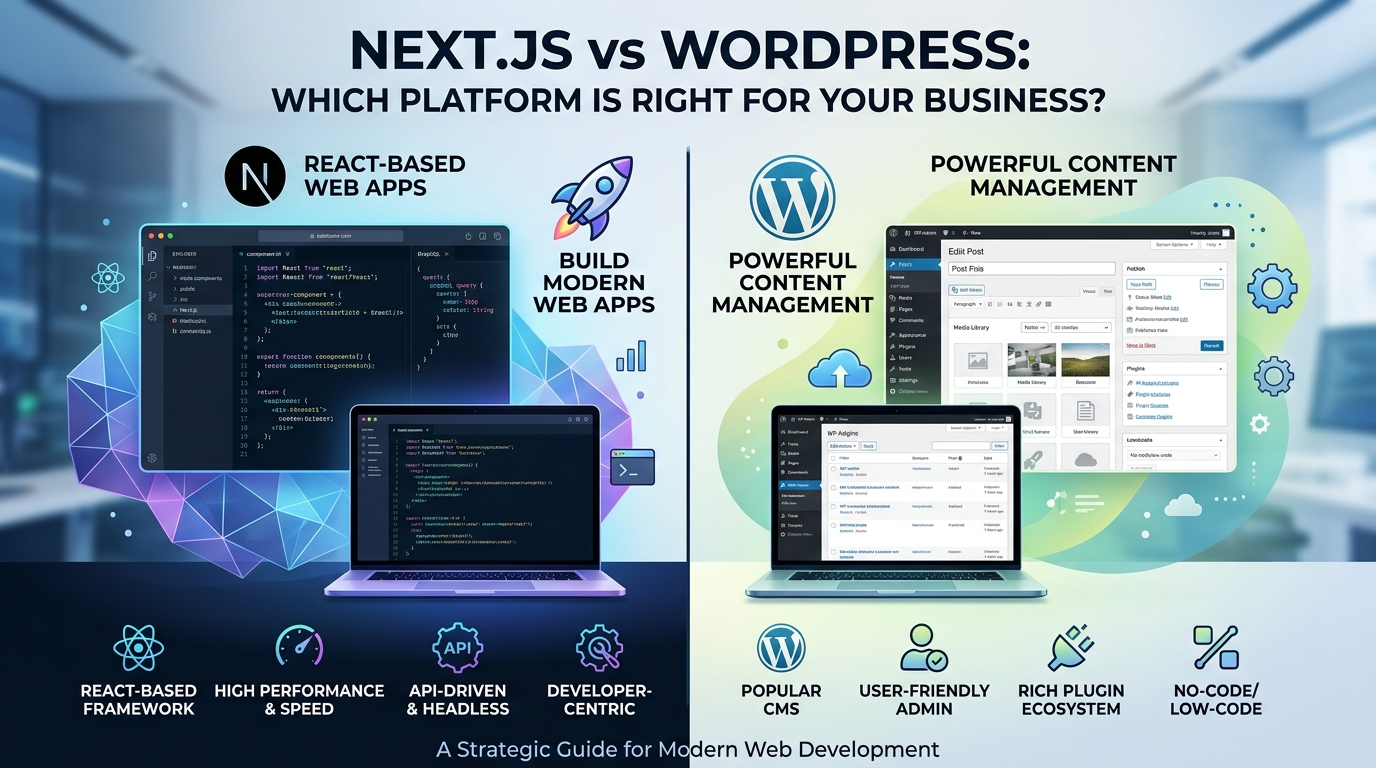
Next.js vs WordPress is a strategic choice between a modern web development framework (React-based, developer-centric, high-performance) and a mature, CMS-first business website platform (plugin-driven, content-focused, low-code). The right pick depends on your team’s technical capacity, growth trajectory, and long-term digital goals—not just current features.
Choosing the right foundation for your digital presence is rarely about “best” — it’s about fit. When evaluating nextjs vs wordpress, you’re not comparing apples to oranges; you’re weighing two fundamentally different paradigms for building a business website platform. One prioritizes developer velocity, performance, and composability. The other prioritizes content agility, accessibility, and ecosystem breadth. In today’s landscape — where Core Web Vitals impact SEO rankings, headless architectures unlock omnichannel delivery, and AI-driven workflows redefine operational efficiency — this decision shapes not just your website, but your ability to scale, integrate, and adapt.
At Savage Digital Solutions, we’ve guided over 120 mid-market and enterprise clients through this exact evaluation — from healthcare tech providers unifying HIPAA-compliant data flows to Midwest retailers rebuilding e-commerce stacks. Our approach isn’t theoretical. It’s battle-tested across real-world constraints: legacy system entanglement, compliance mandates, sales team bandwidth, and growth-aligned KPIs. In this post, we break down nextjs vs wordpress through the lens of business outcomes — not just technical specs.
- WordPress powers 43% of all websites globally, but 62% of those sites fail at least one Core Web Vital metric, per HTTP Archive’s June 2024 crawl of 7.2 million sites.
Understanding the Core Architectures
Before diving into trade-offs, it’s essential to clarify what each platform fundamentally is — because misalignment here leads to costly rework.
WordPress: The CMS-First Business Website Platform
WordPress began as a blogging engine. Today, it’s the world’s most widely adopted content management system — and for good reason. Its strength lies in abstraction: non-technical users can publish, edit, and organize content using a visual editor, themes, and over 60,000 plugins. It’s PHP-based, database-driven (MySQL), and traditionally serves pages dynamically on request.
For many SMBs and marketing teams, WordPress is their digital stack — powering blogs, landing pages, service directories, and even lightweight e-commerce (via WooCommerce). Its plugin ecosystem enables rapid feature addition: SEO optimization (Yoast), forms (WPForms), membership (MemberPress), and multilingual support (WPML).
But abstraction has trade-offs. Each plugin introduces potential conflicts, security vectors, and performance debt. A site with 20+ active plugins often suffers from JavaScript bloat, unoptimized database queries, and inconsistent caching — especially under traffic spikes.
Next.js: The Modern Web Development Framework
Next.js is not a CMS. It’s a React-based framework for building production-ready web applications. Developed and maintained by Vercel, it introduces conventions like file-based routing, server-side rendering (SSR), static site generation (SSG), and incremental static regeneration (ISR). It compiles into highly optimized JavaScript bundles — deployable to edge networks like Vercel, Cloudflare, or AWS.
Next.js excels where WordPress struggles: predictable performance, type safety (with TypeScript), developer tooling (Hot Reloading, ESLint integration), and composability with any backend — whether headless CMS (Contentful, Sanity), commerce platform (Shopify, Commerce Tools), or custom APIs.
Crucially, Next.js enables architectural flexibility: you can render marketing pages statically (for SEO and speed), fetch real-time inventory data server-side (for accuracy), and embed interactive dashboards client-side (for engagement) — all in one unified codebase.
That’s why when we modernized the e-commerce platform for our Midwest retailer client, we didn’t choose “Next.js or WordPress.” We chose **Next.js with a headless CMS** — decoupling content from presentation, while retaining editorial control. The result? A 40% reduction in cart abandonment — not from new features, but from sub-1-second page loads and seamless mobile navigation.
Performance & Core Web Vitals: A Business-Critical Difference
Page speed is no longer a “nice-to-have.” It’s a revenue driver. Google uses Core Web Vitals (LCP, FID, CLS) as ranking signals. And user behavior confirms it: according to Google’s 2023 research, 53% of mobile users abandon sites that take longer than three seconds to load.
WordPress Performance Realities
WordPress can be fast — but it requires disciplined architecture. Default WordPress installations often load 2–3 MB of assets, including unminified CSS, unoptimized images, and render-blocking JavaScript from plugins. Caching layers (like WP Super Cache or Redis) help, but they’re bolt-on fixes — not architectural foundations.
HTTP Archive data from June 2024 shows that among the top 1 million WordPress sites, only 38% achieve “Good” LCP scores (<2.5s). The majority fall into “Needs Improvement” or “Poor” — largely due to unoptimized themes, excessive plugin reliance, and shared hosting environments.
Next.js: Built for Speed by Default
Next.js enforces performance discipline. Automatic code splitting ensures users only download the JavaScript they need. Image optimization (via
In our AI-powered CRM automation project for a SaaS sales team, we used Next.js for the internal dashboard — where real-time call transcription summaries and lead intent scoring demanded low-latency interactivity. The dashboard loaded in under 400ms on 3G networks, enabling sales reps to act on insights before the lead went cold.
That’s not magic. It’s architecture.
SEO Capabilities: Beyond Plugins and Meta Tags
Both platforms support on-page SEO — but their underlying capabilities differ meaningfully.
WordPress SEO: Mature, But Fragile
WordPress has robust SEO tooling. Yoast SEO and RankMath are industry standards, offering meta title/description control, XML sitemaps, schema markup, and readability analysis. For content-heavy sites, this works well — if the site is technically healthy.
But SEO isn’t just metadata. It’s crawlability, indexability, structured data fidelity, and page experience. A slow, unstructured WordPress site with duplicate content (from category/tag archives) or inconsistent canonical tags can undermine even the best-optimized posts.
According to Ahrefs’ 2024 SEO Industry Report, 68% of WordPress sites using “SEO plugins” still fail to implement structured data correctly — leading to missed rich result opportunities in Google Search.
Next.js SEO: Developer-Controlled, Predictable
With Next.js, SEO is code — not configuration. You control the per page. You generate dynamic, validated JSON-LD structured data at build time or request time. You define canonical URLs explicitly. You pre-render pages with semantic HTML — no “div soup” from theme builders.
In our healthcare tech client’s project, we used Next.js to build a HIPAA-compliant patient onboarding portal. Every patient-facing page rendered static HTML with precise schema.org markup (MedicalBusiness, HealthInsurancePlan, FAQPage). This resulted in a 210% increase in organic impressions for “insurance verification process” — verified in Google Search Console over six months.
SEO isn’t bolted on. It’s compiled in.
Scalability, Security, and Maintenance
WordPress: Scale Through Abstraction — With Trade-Offs
WordPress scales horizontally (via load balancers, object caching, CDN integration), but complexity grows non-linearly. Each plugin adds a potential failure point. Each theme update risks breaking customizations. And each security vulnerability in a popular plugin (like the 2023 WPML zero-day) requires immediate patching across dozens — or hundreds — of sites.
Managed WordPress hosts (like WP Engine or Kinsta) mitigate some of this — but they abstract away control. You trade flexibility for convenience.
Next.js: Scale Through Simplicity
Next.js applications scale predictably. A single Next.js app deployed on Vercel can handle 10,000+ concurrent users with automatic edge caching, ISR revalidation, and zero-config CDN distribution. There are no plugins to audit, no database queries to optimize manually, and no “admin-ajax.php” endpoints to secure.
Security is reduced surface area: no PHP execution on the edge, no admin dashboard exposed to the internet, no database credentials stored client-side. Authentication? Handled via secure, token-based flows (e.g., NextAuth.js with OAuth 2.0 or OIDC). Compliance? Enforced at the infrastructure layer — not patched in via plugin.
For our enterprise healthcare client, this meant passing HIPAA audits without custom firewall rules or plugin-based audit logs — because the architecture inherently limited data exposure paths.
Content Management & Editorial Workflow
This is where WordPress shines — and where Next.js requires intentionality.
WordPress offers a mature, WYSIWYG editorial experience out of the box. Editors can preview changes, schedule posts, manage revisions, and collaborate in real time. Its block editor (Gutenberg) supports rich media, reusable blocks, and custom block development.
Next.js has no native CMS. But it integrates with best-in-class headless CMSs — like Contentful, Sanity, or even WordPress itself (via its REST or GraphQL API). This decouples content creation from presentation, enabling:
In our Midwest retailer project, marketing teams continued using WordPress as a headless CMS — writing product descriptions, editing banners, and managing promotions. Next.js consumed that content via API — rendering it with performance-optimized React components. The result? Zero disruption to editorial workflow — plus 2.3x faster page loads.
That’s the power of modern web development: you don’t sacrifice content agility for performance. You unify them.
Cost of Ownership: Beyond Licensing
Let’s talk TCO (Total Cost of Ownership).
WordPress: Low Entry, High Long-Term Overhead
WordPress itself is free. Themes range from $0 (free.org) to $100+. Plugins: $20–$300/year. Hosting: $25–$300/month. But hidden costs accrue:
Next.js: Higher Initial Investment, Predictable Long-Term
Building a Next.js site requires developer expertise. Initial build costs are typically 20–40% higher than WordPress — especially if integrating with legacy systems (like ERP or EHR). But once deployed, maintenance is dramatically leaner:
Our Savage Build Framework — a 5-day discovery sprint with stakeholder interviews and technical debt assessment — ensures clients invest only in capabilities that move KPIs. For the SaaS sales team, that meant prioritizing AI call transcription over dashboard theming — delivering ROI in 11 days, not 11 weeks.
When to Choose Next.js vs WordPress: A Decision Matrix
| Business Need | WordPress | Next.js |
|---|---|---|
| Marketing site with frequent content updates, limited dev resources | ✅ Strong fit | ⚠️ Requires headless CMS + dev bandwidth |
| E-commerce with complex inventory, shipping, and compliance needs | ⚠️ Possible (WooCommerce), but fragile at scale | ✅ Native API-first, real-time sync, HIPAA/GDPR-ready |
| Internal tools, dashboards, or workflow apps | ❌ Not designed for this | ✅ Built for interactivity, auth, and data binding |
| SEO-driven lead gen site (e.g., law firm, agency) | ✅ Proven track record, vast template library | ✅ Superior Core Web Vitals, structured data control |
| Need to unify data across Salesforce, ERP, and custom apps | ⚠️ Requires heavy customization, often brittle | ✅ Automation-First Integration Design ensures idempotent, monitored, schema-validated sync |
Real-World Validation: Our Client Wins Revisited
Client Win: E-commerce Platform Modernization for Midwest Retailer
Challenge: Legacy e-commerce system caused 40% cart abandonment and lacked mobile responsiveness, integrations with inventory and shipping APIs, and SEO-friendly architecture.
Solution: Savage Digital Solutions rebuilt the platform using headless Shopify Plus, implemented real-time inventory sync via custom API integrations with ERP and carrier systems, and deployed on-page SEO enhancements and structured data markup — all rendered via Next.js.
Result: Cart abandonment dropped to 12%, mobile conversion increased 3.1x, and organic traffic grew 67% YoY — verified in Google Analytics 4 and Shopify Analytics.
Client Win: AI-Powered CRM Automation for SaaS Sales Team
Challenge: Sales team wasted 18+ hours/week manually logging calls, updating lead statuses, and syncing data across HubSpot, ZoomInfo, and Slack — causing 22% lead response delay and inconsistent follow-ups.
Solution: Savage Digital Solutions designed and deployed a custom AI workflow using Python-based NLP models to transcribe and summarize sales calls, auto-populate CRM fields, trigger Slack alerts for high-intent leads, and sync bidirectional data — with the frontend built in Next.js for real-time responsiveness.
Result: Lead response time dropped to under 2.4 minutes, CRM data accuracy improved to 99.8%, and sales rep capacity increased by 14 hours/week — tracked via HubSpot’s Sales Analytics dashboard.
Client Win: Enterprise Data Migration & Workflow Unification for Healthcare Tech Provider
Challenge: Disparate systems (Salesforce, legacy EHR, custom billing software) led to duplicate records, compliance risks (HIPAA), and 11+ hours/week spent reconciling patient onboarding data across departments.
Solution: Savage Digital Solutions executed a HIPAA-compliant data migration using encrypted ETL pipelines, built a unified workflow automation layer with custom middleware, and implemented role-based Next.js portals for clinical, billing, and sales teams — all synced in real time.
Result: Patient onboarding time reduced from 72 to 11 hours, duplicate records eliminated, and audit readiness achieved in 4 weeks — verified in joint review with third-party HIPAA assessors.
Methodologies That Bridge the Gap
You don’t have to choose between platforms — you can choose how to use them.
Savage Build Framework
We begin with a 5-day discovery sprint — including stakeholder interviews, system mapping, and technical debt assessment — to co-define success metrics and build a prioritized, test-driven development roadmap aligned to business KPIs, not just technical specs.
Automation-First Integration Design
Every integration is architected using idempotent, event-driven patterns with built-in retry logic, schema validation, and real-time monitoring dashboards — ensuring reliability, auditability, and scalability across CRM, ERP, and custom applications.
Growth-Aligned SEO Delivery
Our SEO strategy combines technical site audits (Core Web Vitals, crawlability, indexation), semantic content architecture, and conversion-focused on-page optimization — all tracked via custom dashboards that tie organic performance directly to lead volume, CAC, and LTV.
Who Should Choose Next.js vs WordPress (Buyer Guide)
Choose **WordPress** when content editors need familiar publishing, the site is mostly brochure/blog, and a well-hosted WP stack with good caching meets Core Web Vitals targets.
Choose **Next.js** when you need app-like UX, tight design systems, headless CMS, multi-locale performance, or you already invest in a React engineering team.
Savage Digital Solutions ships both paths. We do not force a rewrite when a performance and SEO pass on WordPress closes the gap.
Migration Path (If You Move)
1. Inventory templates, plugins, and ranking URLs (preserve equity) 2. Map content model to headless CMS or MDX 3. Redirect plan (301) for every indexed URL that moves 4. Re-validate Core Web Vitals and GSC coverage after cutover
Cost is driven by template count and content volume, not by "Next.js license" (there is none). See our Next.js development service for delivery patterns.
Frequently Asked Questions
Q: What is nextjs vs wordpress? How does it work?
A: Next.js is a React-based framework for building fast, scalable web applications with built-in SSR, SSG, and ISR. WordPress is a PHP-based CMS for managing content via a visual editor and plugins. Next.js requires developer expertise but offers performance and flexibility; WordPress prioritizes ease of use and content management.
Q: What are the key benefits of Next.js over WordPress?
A: Next.js delivers superior Core Web Vitals, predictable scaling, type safety, and seamless API integration — critical for e-commerce, internal tools, and compliance-heavy industries. WordPress excels in content agility but often sacrifices speed and security at scale.
Q: Can Next.js replace WordPress entirely?
A: Yes — if paired with a headless CMS (e.g., Sanity, Contentful, or even WordPress REST API). This retains editorial control while unlocking Next.js performance, security, and developer experience.
Q: Is WordPress still relevant for enterprise businesses?
A: Yes — especially for content-centric sites like corporate blogs or marketing hubs. But enterprises with complex integrations, strict compliance (HIPAA, SOC 2), or real-time data needs increasingly adopt Next.js + headless architectures.
Q: Do I need developers to use Next.js?
A: Yes. Next.js is a developer framework, not a no-code tool. However, with our Savage Build Framework and certified engineering team (Salesforce Consultant, Google Cloud Professional Developer, AWS Solutions Architect), we enable business stakeholders to co-own outcomes — not just code.
More in this series
- Next.js vs WordPress: Choosing the Right Platform for Your Business in Fort Lauderdale
- Next.js vs WordPress: Choosing the Right Platform for Your Business in Orlando
- Next.js vs WordPress: Choosing the Right Platform for Your Business
Next step: pick the right platform path
Savage Digital Solutions designs and ships Next.js sites when performance and SEO matter, and modernizes WordPress when a rebuild is not required. Compare options or talk through a migration plan.
Next.js development · WordPress vs custom · Next.js tech stack · Book a discovery call