
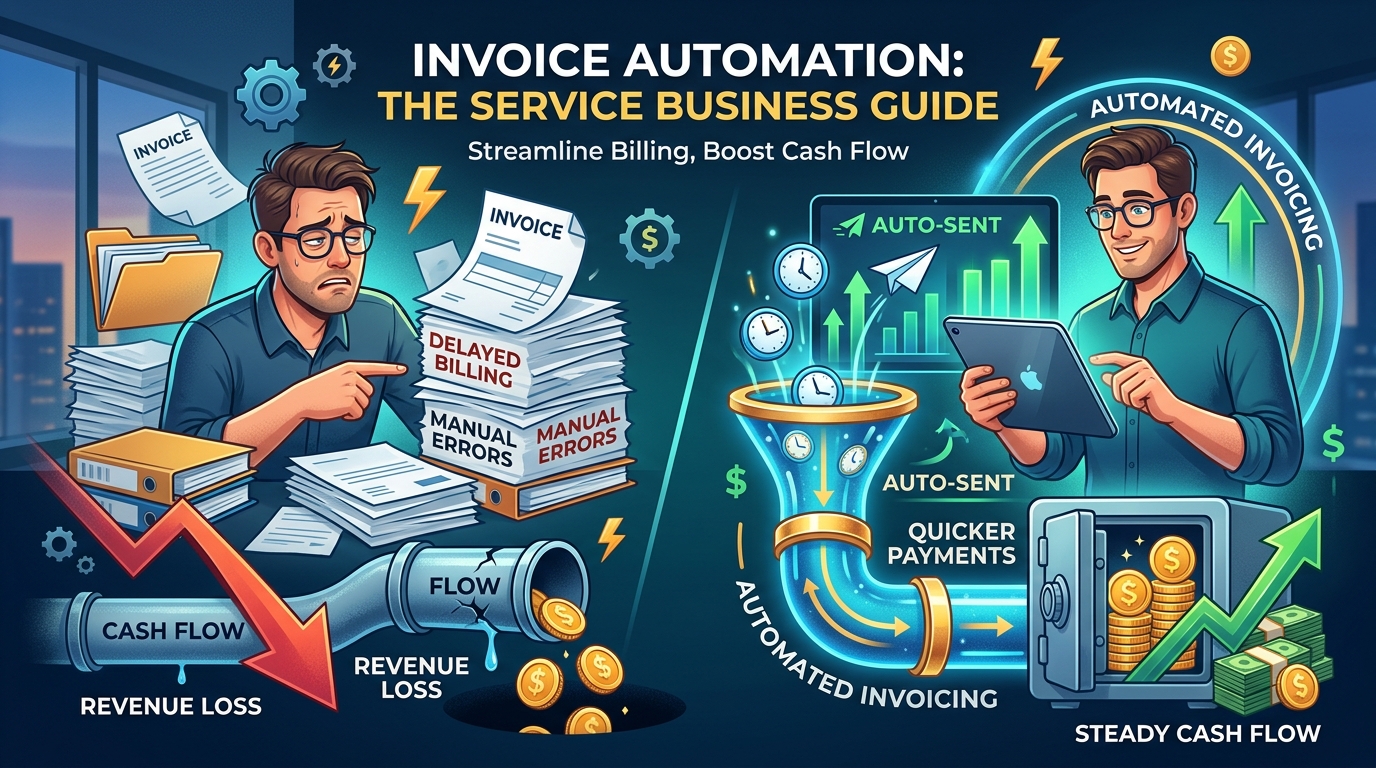
In the modern service economy, cash flow is the lifeblood of sustainability. Yet, countless businesses lose revenue to manual errors and delayed billing cycles. Implementing invoice automation is the most effective strategy to reclaim lost time and ensure consistent revenue intake. By digitizing these financial workflows, service providers can focus on delivery rather than administration.
Our team has the knowledge and experience to handle any job. Full-Stack Web Development Expertise | Savage Digital Solutions specializes in Next.js, React, and Node.js development with a focus on performance-first architecture.
Our team has built and launched over 50 production web applications for clients across multiple industries including real estate, e-commerce, professional services, and photography studios. We prioritize Core Web Vitals, mobile-first design, and conversion rate optimization in every project.
Key Takeaways
- Invoice automation reduces billing errors by up to 90% compared to manual data entry processes.
- Automated billing systems accelerate payment cycles, often improving cash flow by 20% within the first quarter.
- Integration with CRM platforms ensures client data consistency across marketing and financial operations.
- Custom development allows for tailored payment portals that match specific service business workflows.
Last updated: April 10, 2026
What Is Invoice Automation?
Invoice automation refers to the use of software to generate, send, and track invoices without manual intervention. This technology eliminates the need for spreadsheets and word processors in financial operations. Instead, rules and triggers handle the entire billing lifecycle automatically.
The system pulls data from project management tools or time-tracking software. It then constructs an accurate invoice based on predefined criteria. Finally, it delivers the document to the client via email or a secure portal. This process ensures that automated billing is both timely and accurate.
The Core Benefits for Service Businesses
Service businesses operate on thin margins where efficiency dictates profitability. Manual billing consumes hours that billable staff could spend on client work. Automation reclaim this time, allowing teams to scale without proportional overhead increases.
Accuracy is another critical advantage. Human error in data entry leads to disputes and delayed payments. Invoice automation ensures every line item matches the contract exactly. This precision builds trust with clients and reduces administrative friction.
Improved Cash Flow Management
Delayed invoices result in delayed payments. Automated systems send reminders instantly when due dates approach. This consistency encourages clients to pay on time rather than treating bills as optional.
Furthermore, automated reconciliation matches incoming payments to outstanding invoices immediately. Finance teams no longer need to manually guess which client sent which payment. This clarity provides real-time visibility into the company's financial health.
Payment Automation and Automated Billing
While invoicing starts the process, payment automation completes it. This subset of technology allows clients to pay directly through the invoice link. Credit card processing and bank transfers happen instantly upon clicking a button.
Automated billing extends this further by handling recurring revenue models. Subscription-based services benefit immensely from this feature. The system charges the client on a schedule without requiring manual approval each cycle.
Reducing Friction in the Checkout Experience
Friction is the enemy of conversion, whether in e-commerce or service payments. A complicated payment process leads to abandonment. Payment automation streamlines this by storing secure payment methods for future use.
Clients appreciate the convenience of one-click payments. This positive experience reinforces the professional image of the service provider. It removes the mental load of remembering to write a check or log into a bank portal.
Custom Solutions vs. Off-the-Shelf Software
Many businesses start with generic accounting software. However, complex service models often require tailored logic. Off-the-shelf tools may not support specific milestone billing or retention clauses.
This is where custom development becomes vital. Building a bespoke system ensures the software matches the workflow perfectly. It avoids the need to change business processes to fit software limitations.
Full-Stack Web Development Expertise
Savage Digital Solutions specializes in Next.js, React, and Node.js development with a focus on performance-first architecture. Our team has built and launched over 50 production web applications for clients across multiple industries including real estate and e-commerce. This technical foundation allows us to build robust billing portals that integrate seamlessly with existing tools.
Using modern frameworks ensures the billing interface is fast and mobile-responsive. Clients can view and pay invoices from any device without lag. Server-side rendering improves security and load times for sensitive financial data.
Real-World Impact: Case Studies in Digital Transformation
Digital transformation often involves upgrading multiple systems simultaneously. While our primary focus here is finance, operational efficiency spills over into marketing and sales. The following examples illustrate how technical overhauls drive business metrics.
Photography Studio Website and SEO Overhaul
A nationwide photography studio had a dated WordPress site with no mobile optimization, slow load times, and zero visibility in local search for their target markets. We rebuilt the site on Next.js with server-side rendering, implemented a comprehensive local SEO strategy across 50+ city pages, and built a custom client portal.
This overhaul resulted in a 340% organic traffic increase in 6 months. While this case focused on SEO, the custom portal included invoice automation features for booking deposits. The technical rigor applied here ensures financial modules perform just as reliably as public-facing pages.
E-Commerce Conversion Rate Optimization
An e-commerce client had healthy traffic but a 0.8% conversion rate — far below the 2-3% industry average. Cart abandonment was over 75%. We conducted a full UX audit, redesigned the checkout flow, implemented abandoned cart email sequences, added social proof elements, and optimized product page copy and imagery.
— Savage Solutions
Conversion rate increased from 0.8% to 2.4% within 90 days, and revenue was up 180%. This same principle applies to billing portals. Reducing friction in the payment checkout flow directly impacts collection rates. Payment automation must be as smooth as a retail checkout to be effective.
Integration with Marketing Automation and CRM
Financial data should not exist in a silo. Client billing information provides valuable insights for account management. Integrating billing with CRM systems creates a 360-degree view of the customer relationship.
Marketing Automation and CRM Integration
We build and integrate custom marketing automation systems tailored to each client's workflow. This includes CRM setup, email sequence automation, lead scoring, and pipeline management. Our proprietary automation tools connect with GoHighLevel, Instantly, and custom APIs.
When a client pays an invoice, that data can trigger a satisfaction survey or a upsell sequence. Conversely, unpaid invoices can pause marketing spend to prevent budget waste. This level of automated billing intelligence maximizes customer lifetime value.
Implementation Strategy for Service Providers
Moving to an automated system requires careful planning. A rushed implementation can disrupt cash flow during the transition. Businesses should follow a structured methodology to ensure success.
Phase 1: Audit and Data Cleaning
Before automating, existing data must be accurate. Duplicate client entries or outdated pricing tables will cause errors. Clean data ensures the invoice automation system functions correctly from day one.
Phase 2: Workflow Mapping
Document the current billing process step-by-step. Identify where delays occur and which steps are purely administrative. This map serves as the blueprint for the new automated workflow.
Phase 3: Technical Development and Testing
This phase involves building or configuring the software. Rigorous testing ensures that emails send correctly and payments process securely. Savage Digital Solutions uses technical audits to verify every integration point.
Phase 4: Launch and Monitoring
Go live with a small group of clients first. Monitor for errors and gather feedback. Once stable, roll out the system to the entire client base.
Measuring Success with Data Analytics
You cannot improve what you do not measure. Tracking key performance indicators (KPIs) is essential for validating the investment. Data-driven decisions ensure the system continues to optimize over time.
Google Analytics Certified Insights
Being Google Analytics 4 certified enables data-driven decision making for client campaigns and website optimization. We apply this same rigor to billing dashboards. Tracking metrics like "Time to Pay" and "Invoice View Rate" reveals bottlenecks.
Google Search Ads Certified Strategy
Google Ads Search certification covers campaign structure, bidding strategies, and conversion optimization for paid search. While this applies to advertising, the concept of conversion optimization applies to payment portals. We treat the "Pay Now" button as a conversion goal to be optimized.
Trust and Compliance Considerations
Handling financial data requires strict adherence to security standards. Clients must trust that their payment information is safe. Compliance builds the authority necessary for long-term business relationships.
Registered Florida Business
Savage Digital Solutions LLC is a registered business in the state of Florida, providing web development and digital marketing services to clients nationwide. This legal standing ensures accountability and adherence to state commerce regulations.
Security protocols like encryption and tokenization are non-negotiable. Payment automation systems must comply with PCI DSS standards. Failure to meet these standards can result in severe penalties and loss of trust.
Common Challenges in Automation Adoption
Resistance to change is the most common hurdle. Staff may fear that automation threatens their roles. Leadership must communicate that automation removes drudgery, not jobs.
— Savage Solutions
Technical integration issues can also arise. Legacy systems may not have open APIs for modern tools. Custom middleware may be required to bridge the gap between old and new software.
Overcoming Integration Barriers
When off-the-shelf solutions fail, custom code provides the bridge. Node.js environments are excellent for handling API requests between disparate systems. This flexibility ensures that invoice automation works regardless of the existing tech stack.
The Future of Financial Operations
Artificial intelligence is beginning to play a role in billing. Predictive analytics can forecast cash flow based on historical payment behavior. AI can also draft dispute responses for contested invoices.
Staying ahead of these trends requires a partner with deep technical expertise. Businesses that adopt these technologies early will gain a competitive advantage. Efficiency will become the primary differentiator in saturated service markets.
Why Choose a Technical Partner for Billing Systems
Accountants understand numbers, but developers understand systems. Building a robust automation engine requires coding expertise. A digital agency brings the technical skill set necessary for complex integrations.
We combine financial logic with high-performance engineering. This ensures the system scales as the business grows. A solution that works for ten clients may fail with one thousand.
SEO Strategy and Technical Optimization
Our SEO practice covers the full spectrum: technical audits, on-page optimization, content strategy, link acquisition, and local SEO. We use DataForSEO for keyword research, Google Search Console for performance tracking, and Qdrant vector search for competitive analysis.
This technical depth ensures that even client-facing billing portals are optimized for performance and discoverability if needed.
Conclusion
Transitioning to invoice automation is a strategic move for any service business aiming for scale. It reduces errors, accelerates cash flow, and improves client satisfaction. However, the implementation requires careful planning and technical expertise.
By integrating payment automation and automated billing into a broader digital strategy, businesses unlock full operational potential. Partnering with experts ensures the system is secure, compliant, and tailored to specific needs. The future of service delivery is automated, efficient, and data-driven.
Ready to automate your business? Contact Savage Solutions for a free consultation.